
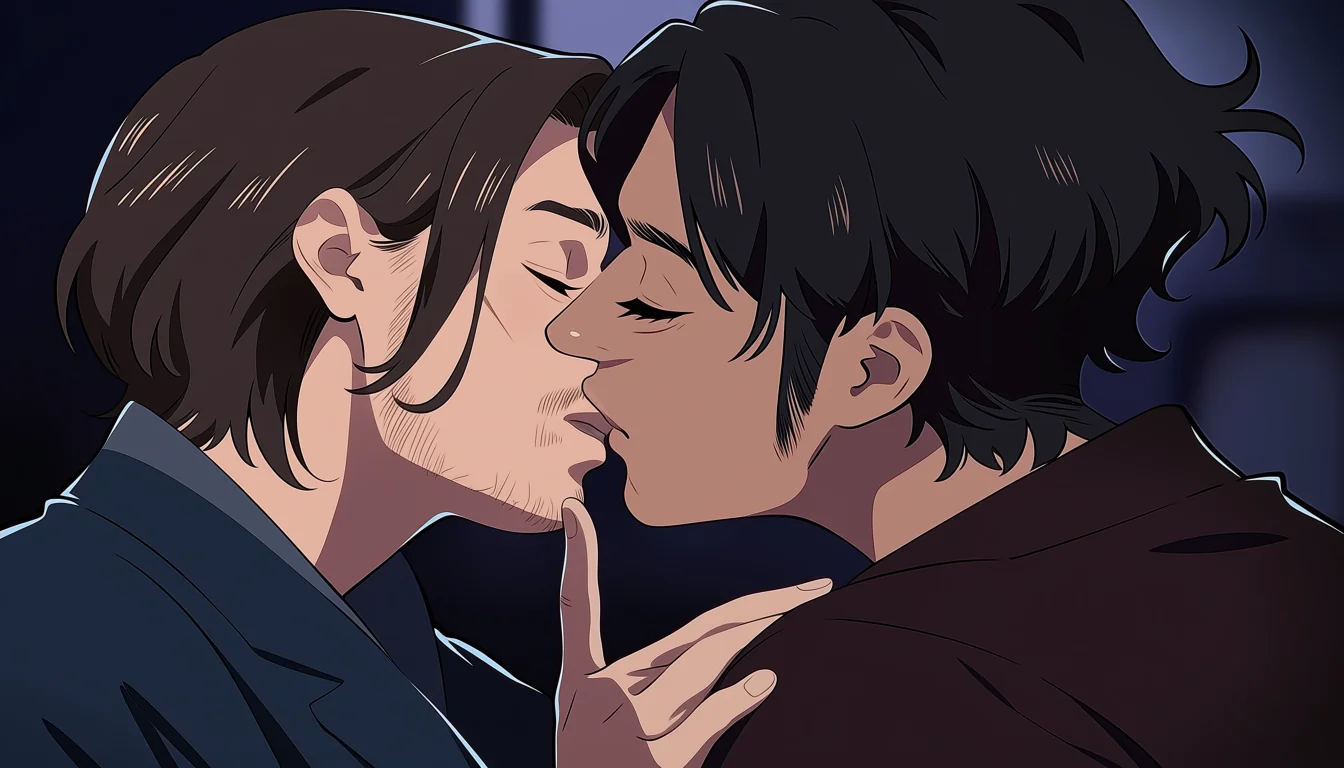
Still illustration and animation are different disciplines, and intimate scenes expose the gap immediately. A drawing can be beautiful and completely fail once it has to move, because movement introduces three problems a single image never has to answer.
Timing does most of the work
The first is timing. A scene's emotional register is set by how long things take, not by what's rendered. Rushed movement reads as mechanical; slow movement with no variation reads as sedated. Neither is a drawing problem.
Crews solve it at animatic stage, where a scene can be retimed in minutes rather than weeks. Play the sequence with no detail at all — flat shapes, no colour — and the pacing problems become obvious. If it doesn't work as grey blocks, more rendering won't rescue it.
Vary the rhythm deliberately. A held beat before a movement carries more than the movement does, which is the same principle behind the comic holds discussed in the late-night house style, used for a different purpose.
Weight and contact are the tells
The second problem is physical. Bodies have mass, surfaces compress where they meet, and hair and fabric lag behind the movement that causes them. Animation that ignores this reads as figures sliding past each other rather than touching.
Three fixes cover most cases: deformation at points of contact, a follow-through delay on anything soft, and a consistent centre of gravity for each figure across the whole shot. None of them require extra frames — they require the frames you already have to be drawn with the contact in mind.
| Problem | How it looks | Fix |
|---|---|---|
| Flat timing | Mechanical or sedated | Retime at animatic stage |
| No contact deformation | Figures slide past each other | Compress surfaces where they meet |
| No follow-through | Hair and fabric feel rigid | Delay soft elements by a frame or two |
| Continuity drift | Room or wardrobe changes | Reference sheet, checked per shot |
Continuity breaks scenes faster than anatomy
The third problem is the least glamorous and the most damaging. Across a sequence, the room changes shape, the light source moves without cause, wardrobe reappears, and the camera crosses the line so left and right swap.
Audiences rarely name these errors. They just stop believing the scene. A short reference sheet — room layout, light source, wardrobe state, screen direction — checked against every shot catches nearly all of it, and almost no small crew makes one.
Screen direction deserves special attention because it's the error people notice least and feel most. Establish which side each character occupies and keep it, or give the audience a clear reason for the change.
Staging comes before any of this
All three problems get easier if the scene was staged properly first. Establish the geography with a wider frame, decide what the audience must understand at each beat, then move in. Closing in before the space is established is the single most common cause of confusing sequences.
That sequencing method is the whole argument of the blocking guide, and it applies to animation even more than to stills, because a moving camera can lose an audience in a way a single frame can't.
Lighting supports it. Bodies need to separate from backgrounds by value rather than by outline alone, which is harder in low light and worth planning early — covered in the piece on night palettes.
Intent has to be animated too
Everything above is technique. The part that isn't optional is what the movement communicates. Mutual intent reads through performance: response timing, returned attention, hands that rest rather than grip, pacing that isn't hurried.
Characters are fictional and unmistakably adult, with no ambiguity about age, no real-person likeness, and no coercion framed as romance. Those standards are written out in the control room, and connected creation with real account and moderation controls stays on anime AI generator.
What moving images demand that stills don't
A still can imply. Animation has to commit — to a duration, a weight, and a sequence — and every one of those commitments can be wrong in a way a single frame never is.
That's why so much work in this space stays still. It's also why the animated work that does succeed tends to be short: a small number of shots, timed carefully, with continuity somebody actually tracked. Do those three things and the drawing quality matters far less than anyone expects.