
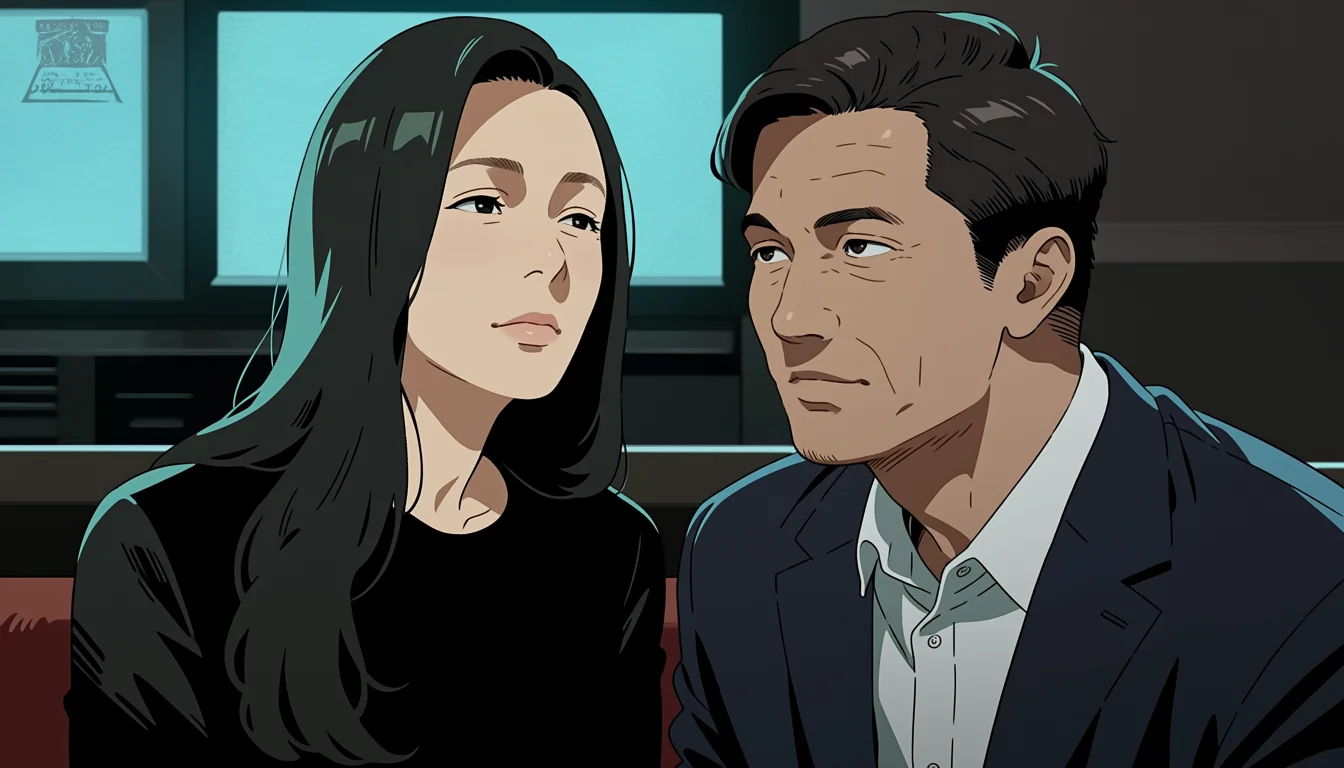
The hardest thing to draw in an explicit scene isn't anatomy. It's the relationship. A frame can be technically flawless and still read as ambiguous, uncomfortable, or one-sided, and the reasons are usually compositional rather than moral.
The signals that actually read
Four things carry intent in a still image, in roughly this order of strength.
- Reciprocal attention. Both characters are engaged with each other rather than one being looked at.
- Posture. Weight distribution shows whether someone is settled or braced.
- Hands. Resting, holding, or guiding reads very differently from gripping or restraining without context.
- Environment. A chosen, comfortable space reads differently from an improvised or hostile one.
Reciprocal attention does the most work and is the most often missed. When only one character is depicted as a participant and the other is depicted as a subject, the frame reads one-sided regardless of what the artist intended.
Coercive framing enters through the camera
Here's the part artists rarely think about. Camera position carries meaning independently of content. A viewpoint that consistently excludes one character's face, that looks down from above at one person and up at the other, or that keeps one figure cropped, builds an imbalance the drawing itself never stated.
This is ordinary film grammar. High and low angles have carried status since cinema began, and drawn work inherits every bit of it. Choose the angle deliberately or it will choose a meaning for you.
The fix is to check the sequence rather than the frame: across several images, does each character get looked at and get to look? Persistent asymmetry is the signal to fix.
Cropping works the same way. A figure repeatedly cut at the neck or the shoulders stops being a person in the scene and becomes scenery, and that shift happens without any deliberate decision. Keeping faces in frame at least intermittently costs nothing and changes the read completely.
| Choice | Reads as | Correction |
|---|---|---|
| One face excluded | Objectification | Give both characters visible attention |
| Consistent high angle on one | Status imbalance | Vary or equalise camera height |
| Rushed pacing | Pressure | Add a held beat before the turn |
| Improvised setting | Opportunism | Make the space look chosen |
Why captions don't work
Text placed outside a picture changes nothing about the picture. Nobody reads a disclaimer before looking, and even if they did, the image would still communicate whatever it communicates.
The same applies to tags and metadata. Those are filing tools, useful for filtering as we set out in the piece on how genre tags work, but they don't alter what a frame shows. Meaning has to be built into the composition.
Artist statements have the same limitation. Explaining afterwards what a scene was supposed to convey is a good sign that the scene didn't convey it. If the explanation is necessary, the frame needs another pass rather than a longer caption.
Pacing across a sequence
In multi-panel or multi-frame work, pacing carries as much intent as any single image. A sequence that moves straight to the explicit beat reads as pressured; one that includes arrival, hesitation, and agreement reads as mutual.
You don't need many panels for this. Two or three establishing beats are usually enough, and they also solve the geography problem that makes tight framing confusing later — the sequencing habit described in the blocking guide.
In animation the same logic applies through timing, which is its own set of problems covered in the piece on animating intimate scenes.
The standards under all of it
Characters are fictional and unmistakably adult. No ambiguity about age, ever. No real-person sexual depiction. No coercion presented as romance. No traced or stolen artwork.
Those are the floor rather than a style preference, and they're written out in the control room's editorial standards. Where creation, accounts, credits, and consent checks are involved, they stay with the platform that runs them, at anime AI generator.
Making mutual intent visible in the frame
The summary is short. Give both characters attention. Choose the camera height on purpose. Let posture and hands do their job. Build two or three beats of pacing before the explicit one.
Work made that way reads clearly to a viewer who knows nothing about the artist's intentions, which is the only test that matters — because that's every viewer.